





What Is Source to Contract (S2C)? Definition, Process and Software
Source to Contract (S2C) is the end-to-end procurement process that covers everything from identifying a sourcing need through to the signed supplier contract. It encompasses spend analysis, market research, supplier identification, RFQ/RFP management, bid evaluation, supplier selection, negotiation, and contract execution. S2C is the upstream, strategic half of the broader procurement lifecycle: at the end of the S2C process, no orders have been placed and no money has changed hands.
What Does Source to Contract Include? The S2C Process Steps
A well-run source to contract process follows a structured sequence. The exact steps vary by category complexity, but the standard framework covers the following steps:
- Spend analysis and category strategy: Identify what needs to be sourced, review historical spend, and define the category approach via category management. This phase sets the strategic direction and surfaces cost saving opportunities before a single RFQ is issued.
- Market research and supplier identification: Assess the supply market, identify potential suppliers, and evaluate their capabilities, financial stability, and compliance posture. Monitoring market trends at this stage sharpens the sourcing strategy and strengthens the negotiating position.
- Supplier qualification: Shortlist suitable suppliers based on pre-defined criteria. This may involve sending an RFI (Request for Information) to gather supplier data and assess supplier risk before issuing a formal tender.
- RFx creation and distribution: Issue an RFQ (Request for Quotation) or RFP (Request for Proposal) to the qualified vendor pool. Structured templates allow like-for-like comparison of offers and support a transparent, auditable bidding process.
- Bid receipt and evaluation: Score incoming bids against predefined criteria - typically price, quality, delivery schedules, and compliance. Weighted scoring models or MEAT (Most Economically Advantageous Tender) approaches are common. Good procurement analytics at this stage support better decision making.
- Supplier selection and negotiation: Advance the preferred supplier(s) to commercial and legal negotiation. The goal is to negotiate favourable terms on pricing, payment, SLAs, and contractual obligations, and to establish a clear basis for supplier relationship management going forward.
- Contract award: Formally select the winning supplier and communicate the decision. In public procurement, a mandatory standstill period applies before the contract becomes binding.
- Contract creation and execution: Draft, review, and execute the contract. With digital platforms, contract creation includes e-signing and automatic activation of the contract lifecycle management process, ensuring all contract terms are captured and managed centrally.
Source to Contract vs. Procure to Pay vs. Source to Pay
S2C is frequently confused with the two related frameworks it sits within.
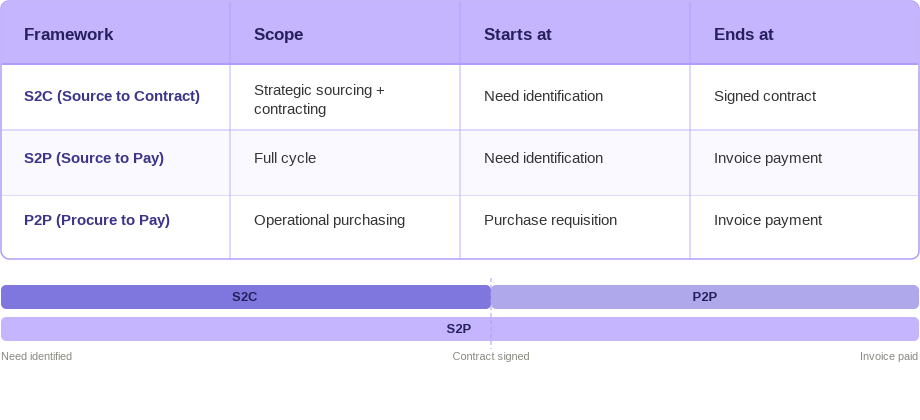
The key distinction: S2C ends where P2P begins.
S2C is about building the commercial framework: selecting suppliers, negotiating terms, and executing contracts. P2P executes against that framework: raising purchase orders, receiving goods, processing invoices, and making payments. S2P is the umbrella term that covers the entire procurement cycle from first sourcing activity to final payment. See the full source to pay process wiki entry for more detail.
Why Source to Contract Matters for Procurement Teams
A structured S2C process delivers measurable outcomes across four areas.
- Cost savings and better terms: Competitive tendering creates leverage through better pricing, payment terms, and volume discounts. Structured S2C processes typically generate savings of 5–15% on addressable spend, with the greatest gains at the category management stage.
- Maverick spend reduction: Without a formalised path from need to contract, spend leaks to unapproved suppliers. S2C closes this gap by establishing a documented, auditable route from requirement to signed contract.
- Compliance and audit trail: Regulations including CSDDD, LkSG, and the UK Modern Slavery Act require organisations to demonstrate supplier due diligence. A structured S2C process generates detailed audit trails: every decision, from evaluation scores to negotiation notes, is traceable.
- Stronger supplier relationships: Formalised evaluation and selection set expectations clearly on both sides, supporting longer-term collaboration, supplier performance tracking, and continuous improvement in supplier relationship management.
How Technology Supports the S2C Process
Before digital platforms, procurement teams ran S2C processes in spreadsheets and email, prone to error, with no real-time visibility and no structured audit trail. Modern source to contract software automates the most time-consuming upstream processes, improving operational efficiency and giving procurement operations full spend visibility across the entire procurement lifecycle.
- RFx automation: Create, distribute, and manage RFQs and RFPs from a single platform. Supplier responses come in via a structured portal, not disparate email threads.
- Bid comparison and scoring: Structured templates allow direct side-by-side comparison. Weighted scoring matrices are applied consistently, reducing evaluation time and eliminating subjectivity from the bidding process.
- AI-assisted supplier selection: Analytics tools analyse supplier data, flag anomalies, and surface the best suppliers based on price, quality, risk assessment, and strategic fit.
- Digital contract creation and e-signing: Generate contract drafts from agreed commercial terms and manage contracts digitally, eliminating the lag of manual document exchange.
- Detailed audit trails: Every action, approval, and decision is logged automatically, supporting risk mitigation, compliance, and internal governance.
- Seamless handoff to contract management: Once a contract is executed, it moves into the contract management lifecycle for ongoing monitoring of contractual obligations, renewal tracking, and performance management.
Conclusion
Source to contract is the strategic foundation of any well-run procurement operation. It brings structure to the entire journey from spend analysis to signed contract, ensuring that supplier selection is competitive, negotiation is data-driven, and every decision is documented and traceable. Without a structured S2C process, procurement teams risk maverick spend, compliance gaps, and missed cost saving opportunities.
As regulatory requirements grow and supply chains become more complex, a clearly defined source to contract process is no longer optional, it is a core procurement practice. The right source to contract software makes this process faster, more consistent, and scalable across the entire organisation.
FAQs
What does source to contract mean in procurement?
Source to contract (S2C) is the end-to-end procurement process that runs from identifying a sourcing need through to the execution of a signed supplier contract. It covers spend analysis, market research, supplier identification, RFx management, bid evaluation, negotiation, contract award, and contract creation. S2C is the strategic, upstream half of the procurement lifecycle: it establishes the commercial framework that operational purchasing then executes against.
What is the difference between S2C and P2P?
Source to contract (S2C) covers the strategic part of procurement: selecting suppliers, running tenders, negotiating contract terms, and signing contracts. Procure to pay (P2P) covers the transactional part: raising purchase orders, receiving goods, processing invoices, and making payments. S2C ends when the contract is signed. P2P begins from there. Source to pay (S2P) is the umbrella term for the entire procurement lifecycle that includes both.
What are the steps in the source to contract process?
A standard source to contract process covers eight steps: spend analysis and category management, market research and supplier identification, supplier qualification, RFx creation and distribution, bid receipt and evaluation, supplier selection and negotiation, contract award, and contract creation and execution. The complexity of each step varies by category: a low-value indirect purchase may need only a streamlined RFQ process, while a strategic direct materials category may involve multi-round bidding and extensive contract drafting.
What software supports source to contract?
Source to contract software (sometimes called e-sourcing platforms or strategic sourcing suites) automates the key procurement activities of the process: RFx management, bid comparison, supplier qualification, scoring, and digital contract creation and e-signing. The right procurement platform centralises all sourcing activity, creates detailed audit trails, and integrates with contract lifecycle management for seamless post-award execution.
How does source to contract improve compliance?
S2C improves compliance in two ways. First, it creates a documented, auditable procurement process: every evaluation decision, negotiation point, and approval is recorded, satisfying internal governance requirements and supporting external audits. Second, it enables systematic supplier due diligence at the selection stage, helping organisations meet obligations under regulations such as CSDDD, the German LkSG, and the UK Modern Slavery Act.